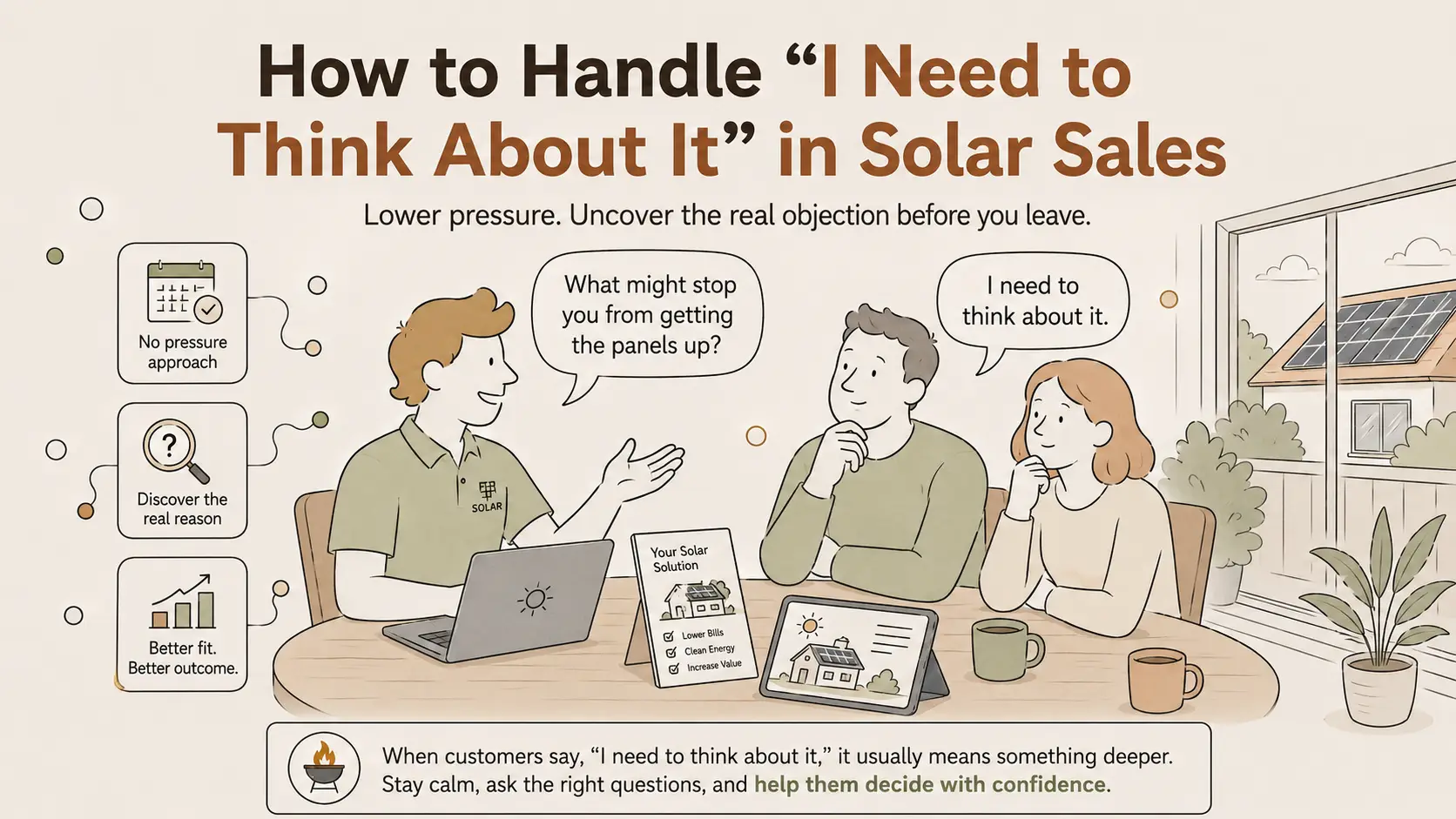

How to Handle “I Need to Think About It” in Solar Sales

How to handle “I need to think about it” in solar sales, lower pressure, and uncover the real objection before you leave.
How to Handle “I Need to Think About It”

Look, every solar closer has been there.

You’ve done the appointment. You’ve walked the roof. You’ve looked at the bill. You’ve gone through the system, the battery, the install, the price, the whole lot.

Then the customer leans back and says:

“I need to think about it.”

Or:

“Just send it through.”

Or:

“We’ll talk about it and get back to you.”

And right there, most reps lose the sale.

Not because the customer said no.

Because the rep leaves without finding out what the customer actually needs to think about.

That’s the problem.

They might be worried about price. They might need their partner to be comfortable. They might be unsure about the battery. They might be waiting for better technology. They might like you, like the system, like the company, but still not feel certain enough to move.

If you walk out with a vague maybe, you’ve got nothing.

You’ve got a quote sent.

You’ve got a follow-up task.

You’ve got hope.

Hope is not a sales process.

Why “I Need to Think About It” Is Not the Real Answer

“I need to think about it” sounds reasonable.

And sometimes it is reasonable.

Solar is a proper decision. It’s not buying a toaster. There’s money involved, there’s a roof involved, there’s sometimes finance involved, and there’s often another decision maker involved.

So don’t be the rep who treats every delay like the customer is mucking you around.

That’s not the move.

But here’s the part most reps miss.

The words “I need to think about it” don’t tell you anything useful.

Think about what?

The price?

The battery?

The installer?

The finance?

The timing?

The partner?

The other quote coming tomorrow?

Until you know that, you’re blind.

A vague yes is still a no.

“Yeah mate, looks good, send it through,” sounds nice. But if there’s no clear next step, no clear reason, and no real concern on the table, you haven’t closed anything.

You’ve just politely exited the appointment.

Don’t Get Pushy When You Feel Pushy

So, first rule.

If you feel pushy, stop pushing.

Most reps do the opposite. They feel the sale slipping, so they start talking more. They justify the price again. They explain the panels again. They bring up another feature.

They chase the yes.

The customer feels it.

And once they feel it, they protect themselves.

That’s when they say:

“Yeah, no worries, just send it through.”

“Leave it with me.”

“We’ll come back to you.”

So slow down.

Lower the tension.

You might say:

“Yeah, no worries. I completely get it. Most people want to have a think before making a decision like this.”

That takes the heat out of it.

You’re not fighting them. You’re not begging. You’re not trying to jam a contract under their nose.

You’re staying in the conversation like a professional.

Then, once the pressure drops, you ask the real question.

The Question You Must Ask Before You Leave

This is the key move. Before you leave, ask what might stop them. Not in a weird salesy way.

Not like:

“What objections do you have?”

No normal person talks like that. Say it like a human.

“Before I shoot off, while you’ve still got me here to answer any last questions, what do you reckon might stop you from getting the panels up?”

That’s the question.

That’s the one most reps avoid.

And it matters because once you leave, everything gets harder.

They’ve got your quote. The emotional part of the appointment is gone. They can compare your price against the cheap mob. They can ask a mate who knows just enough to be dangerous. They can talk themselves out of it.

So ask while you’re there.

If there’s a real issue, you want it on the table now.

Not three days later over SMS.

Why “Any Questions?” Is Too Weak

A lot of reps ask:

Any questions?

The customer says:

“No, all good.”

Then the rep asks:

“Are you sure?”

That’s weak.You’ve asked the same thing twice. Now it feels awkward.The better move is to explain why you’re asking the harder question.Don’t sell the system again.Sell the reason for the question.Try this:

“The only reason I ask is because once I leave, it’s a lot harder to go through anything properly. So while I’m still here, what do you think might stop you from getting the panels up?”

That feels fair.It gives the customer a reason to answer honestly.You’re not cornering them. You’re helping them avoid sitting with a concern you could have cleared up in two minutes.That’s solid. That’s solid.

When They Say “Send It Through”

Look, “send it through” is not a win by itself.It’s not always bad. You can send the quote. But don’t let “send it through” become your escape hatch.Here’s the cleaner way:

“Yeah, no worries. I’ll send it through. The quote is valid for 28 days, so that gives you enough time to get your head around it. Before I shoot off though, while you’ve still got me here, what might stop you from getting the panels up?”

That line does a few things. It agrees. It lowers pressure. It gives them space.Then it brings the real concern into the room. That’s the difference between being pushy and being clear. A pushy rep tries to force the yes. A clear rep asks what’s stopping the yes.

When They Need to Talk to Their Partner

So, the partner one: “We need to talk about it” is usually in the same family as “I need to think about it.” Don’t fight it. They should talk. Both people should be comfortable. But you still need to know what might come up in that conversation.
Say:

“Of course. You both need to be happy with it. Before you have that chat, what do you think might be the main thing that could stop you both from going ahead?”

That is not pressure. That is common sense. And if you’re getting the partner objection all the time, look earlier in your process.You probably missed a step. Maybe both partners weren’t there. Maybe one partner was physically there but mentally checked out. Maybe the husband wanted the battery and the wife never really bought into why they needed it. Maybe the wife thought you were doing two split systems and the husband thought four. That stuff doesn’t magically appear at the close. It was there earlier. You just didn’t pull it out. So when you’re in the home, keep both people in the conversation.
Ask:

“Mary, does that make sense to you as well?”

Or:

“James, are you seeing this the same way, or are you thinking about it differently?”

Look for the quiet one. The quiet one often becomes the objection later.

The Double “I Need to Think About It”

Here’s where it gets trickier. You ask what might stop them. They say:

“Nothing really. We just don’t make decisions on the spot.”

That’s the double “I need to think about it.” You’ve opened the door, and they’ve still given you the same line. Don’t just repeat yourself. Don’t go back to the whole presentation. Don’t start defending the quote. You need to separate habit from concern.

“Yeah, fair. Some people are like that. Can I ask, is it just that you never make decisions on the spot, or is there something about this deal that still doesn’t feel quite right?”

That’s a good question. Now they’ve got two paths. If it’s just their normal buying style, you can respect it.If something still feels off, you can deal with it. And often, what they really mean is:
“I want to make sure this is a good deal.” So help them say that.

“So is the main thing just making sure you’re getting the right deal here?”

Once they admit that, you’re back in a proper sales conversation. Now you can use the three things close. Now you can talk through the value. Now you can give them new information that helps them make a cleaner decision.

That’s what happened with one closer’s customer. She was the type of person who said she never made decisions on the spot.

She’d taken years to decide on smaller things. But through the process, she got to the point of pulling out her card and putting in payment details.

The point is not that everyone will do that. They won’t. The point is that “I never decide on the spot” is not always the end of the conversation. Sometimes it’s just the first layer.

Hidden Objections to Listen For

Most “think about it” objections hide one of a few things. Price is the big one.
They might say:

“It’s not really a priority.”

But what they mean is:

I’m not sure the numbers make sense.”

So ask:

“When you say it’s not a priority, is it because solar itself isn’t important right now, or because you’re not sure the deal makes sense?”

Partner certainty is another one. 
They say:

“We’ll talk about it.”

You ask:

“What do you think will come up when you talk about it?”

Too many options is another. If you give them too many panels, too many batteries, too many system sizes, and too many extras, you create confusion. Confused customers delay. So make the decision simple.

“The only reason you’d spend more on this option is if this part is important to you. Is that important, or not really?”

That keeps the customer moving. Future technology is another one. They might be thinking: “What if better batteries come out soon? ”Don’t make big claims you can’t back up.
Just ask:

“Are you waiting for something specific, or is it more the worry that something better might come out later?”

That tells you what you’re dealing with.

FREE DOWNLOAD

Grab the “I Need to Think About It” Script Pack

Most reps either push too hard or leave too early when a homeowner says, “I need to think about it.”

This script pack gives you 6 calm responses for the moments customers say:

  • Send it through
  • Leave it with me
  • We need to talk
  • We never decide on the spot
  • It’s not a priority
  • This feels pushy

Use it before you leave the appointment, so you can lower the pressure, uncover the real objection, and keep control of the conversation.

Download the Script Pack
Built for solar closers, sales managers, and business owners who want cleaner conversations without sounding pushy.

Final Word

Look, the customer is allowed to think. That’s not the issue. The issue is when you leave without knowing what they need to think about.

That’s where deals go missing. That’s where your quote gets donated to the cheaper competitor.

That’s where your margin gets chopped up in follow-up.

So stop treating “I need to think about it” like the end of the appointment.

It’s not. It’s the moment where you slow down, lower the pressure, and ask the final question.

“What might stop you from getting the panels up?”

Ask it calmly. Ask it while you’re still there. Then shut up and listen. That one question will tell you whether you’ve got a price problem, a partner problem, a timing problem, a confusion problem, or just a customer who needs help making a clean decision.

You won’t close everyone. Good. You’re not supposed to. But you’ll stop walking away from deals that were closer than you thought.

If you want to find out where your solar sales process is leaking leads, margin, and time, take the Solar Sales Scorecard.

It’ll show you where the breakdown is happening before another quote goes out and never comes back.

Find out where your solar sales process is leaking leads, margin, and time.

Find & Fix Leaks in Your Solar Sales Process

Take the 7-minute Solar Sales Scorecard and get a personalised report showing where your team is losing deals, margin, and time.

Take the Scorecard
100% free • No spam • Instant results

More Posts